


May 29, 2026
-Talisa Young
Let’s be honest, most of us are using AI tools. For drafting emails, writing captions or even more serious for Cyber Security helping with prevention, it’s become part of the workflow and frankly it has saved everyone a lot of time! But here’s what nobody wants to admit: it’s often painfully obvious when something has been written by AI. And if you’re using it for the wrong things or not editing it properly, people notice – and you’re doing yourself an injustice. Even though everyone uses AI, not everyone noticeably uses it, and that’s what can set you back.
Here are 6 tell-tale signs your content was written by a robot.
You asked AI to help with a quick email to a colleague. It comes back opening with “I hope this message finds you well” and closing with “Please do not hesitate to reach out should you require further clarification.”
Nobody talks like that. When AI handles informal or emotionally sensitive communication, you come across as cold or like you simply couldn’t be bothered. The recipient feels that distance, even if they can’t name why.
The rule: If you’d be embarrassed to say it out loud, don’t send it in writing.
If your content opens with “In today’s fast-paced world…”– congratulations, you’ve officially made it really obvious.
AI gravitates toward the safest, most common phrasing: “It is important to note…”, “With that being said…”, “Let’s dive in!” These aren’t technically wrong. They’re just verbal wallpaper – present but contributing nothing.
Real writing has specificity. “Three years ago I lost a client over one bad email” is interesting. “Effective communication is crucial in a professional setting” was written by a language model.
AI sounds informed, and it is – it’s been given a brief, and it follows it. What it can’t give you is a genuine opinion or a relevant story only you could tell.
The best content is rooted in something real- a mistake you made, a client situation that went sideways, the belief you held for years that turned out to be wrong. AI doesn’t have those stories, you do. In a world where everyone has access to the same tools, that’s your creative advantage.
AI-generated content feels oddly even. Every paragraph the same length. Every section follows the repetitive pattern, and it’s boring, where transitions like “Furthermore,” and “In conclusion,” appear on cue.
Human writing doesn’t work like that. Some paragraphs are one sentence long because that’s all they need. Others need space and a story to illustrate them. AI flattens all of that into a predictable grid that’s easy to read yet very easy to notice.
AI can produce 500 words on any topic and leave you feeling like you’ve learnt nothing. It expands, elaborates, “delves into” things – but the actual insight at the end is usually just: it depends. Though it has a nice flow and formal tone, it’s impersonal and doesn’t have much substance/valuable information backing it.
Good writing respects the reader’s time and it is engaging (because not only can reading be time-consuming but also boring!). After making a point, backs it up, and moves on. Wordy but shallow, is not only a huge giveaway but also boring for the reader!
This is the hardest to define but easiest to recognise and feel. Your audience whether; followers, colleagues, or clients has a sense of how you write. Your rhythm, your humour, the way you phrase things.
AI produces competent, clean writing that could have come from anyone. If people are used to hearing you, that anonymity is annoying, and they acknowledge it instantly!
So Should You Stop Using AI?
No. That’s not the point.
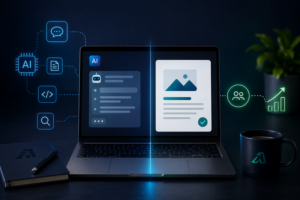
AI is genuinely useful for the right things – brainstorming, beating a blank page, summarising research, drafting templates and FAQs. Where it falls short is personal communication, anything where your unique perspective matters, or any situation where being caught using it would undermine your credibility.
The best content uses AI as a starting point, and a starting help only. Get the draft down, then edit ruthlessly. Add your opinions. Cut the filler. Put yourself back into your work.
The goal isn’t to use AI less. It’s to use it smarter, and to make sure the final version always sounds like you, with AI helping your work, not being your work.
Want more insights on this or other IT Topics, check out our blogs and for more information or if you fancy a chat with one of our IT experts contact us.

Read full story

Read full story
Read full story

Read full story
Read full story

Read full story

Read full story

Read full story

Read full story

Read full story